Security testing used to be an event. It was a well-defined project with a start date, an end date, and a final report. Once a year, a company would invite ethical hackers to probe its defenses, and for two weeks, development would slow down as everyone braced for the findings. The final PDF report would serve as the security bible until the next annual ritual.
This model was designed for a world where software was shipped quarterly. But that world is gone. Today, code is not an event; it's a constant flow. With CI/CD pipelines deploying new features multiple times a day, the annual pentest has become a fundamentally broken paradigm. It’s like installing a smoke detector but only turning it on for one week a year.
To keep pace with modern development, security is undergoing a radical transformation. We are moving away from the isolated event of a traditional pentest and toward a new model of continuous, AI-driven testing. This isn't just an upgrade in tooling; it's a fundamental shift in philosophy that turns security from a development bottleneck into an enabler of speed and innovation.
The Flaw of the "Snapshot" Security Model
A traditional penetration test provides a snapshot in time. It tells you how secure your application was on the day the test began. The moment a developer pushes new code, that snapshot becomes obsolete. This latency between testing and deployment creates a window of opportunity for attackers.
In an agile environment, this model creates friction. Engineering teams are incentivized to move fast, while security teams are forced to say "slow down." This adversarial relationship leads to one of two outcomes: either security becomes a gatekeeper that stifles innovation, or it is bypassed entirely in the name of progress, accumulating massive security debt.
The core problem is that manual testing cannot operate at the speed of modern software delivery. You cannot hire enough human experts to manually test every single code commit. The process is too slow, too expensive, and simply doesn't scale.
Continuous Testing: Security as a Flow, Not an Event
The solution is to embed security directly into the development lifecycle, transforming it from a separate event into a continuous flow. This is the principle behind continuous testing, a practice where automated tests are executed as part of the software delivery pipeline.
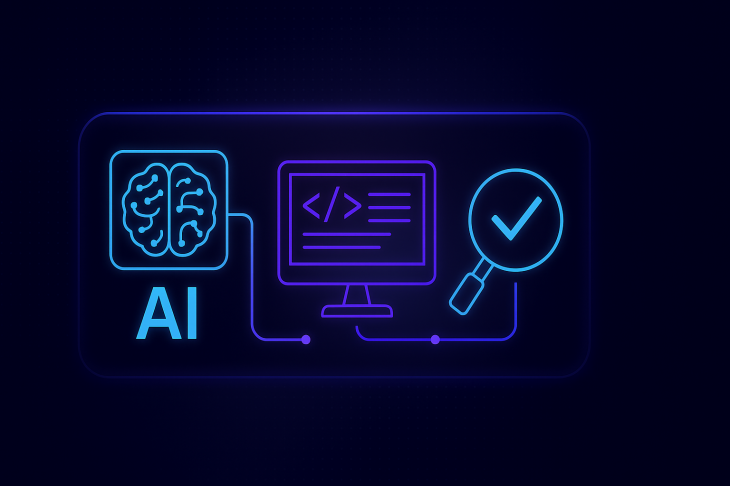
When this concept is applied to security, it means that every code change is automatically assessed for vulnerabilities before it ever reaches production. This is where AI pentesting becomes a game-changer.
Unlike simple scanners that just check for known signatures, AI-driven tools simulate the behavior of a human attacker. They attempt to verify and exploit potential vulnerabilities, providing developers with high-fidelity results directly in their workflow. This delivers several key advantages:
1. Immediate Feedback: A developer is notified of a potential security flaw within minutes of writing the code, not weeks later. This makes remediation faster and cheaper, as the context is still fresh.
2. Elimination of Noise: By attempting to confirm exploitability, AI reduces the flood of false positives that plagues traditional scanning tools. This allows teams to focus on real, verifiable risks.
3. Infinite Scalability: An AI-powered platform can test thousands of commits across hundreds of microservices simultaneously, something that would require a massive and costly team of human pentesters.
This approach aligns with the principles of DevSecOps, which advocates for making security a shared responsibility. You can explore more on this integrated approach through resources like the DevSecOps Manifesto, which emphasizes building security in rather than bolting it on.
To see how AI-driven automated testing can elevate your organization's security workflow, explore AI pentesting for end-to-end coverage in agile and DevOps environments.
From Bottleneck to Business Enabler
When security operates at the same velocity as development, it stops being a blocker. Instead of filing a ticket and waiting for a security team to review it, developers get actionable feedback directly in their pull requests. They can fix the issue on the spot, often with a single click to update a vulnerable dependency.
This shift has a profound cultural impact. Security is no longer the "department of no." It becomes a supportive function that provides the guardrails necessary for developers to innovate safely and quickly. When you can prove that every release has been automatically tested against the latest attack vectors, you can deploy with confidence.
This move toward continuous, automated assurance is reflected in broader industry trends. Research from organizations like Gartner highlights a move toward "Continuous Threat Exposure Management" (CTEM), a framework built on the idea that cyber defense must be as constant and dynamic as the threats themselves. You can read more on their analysis of top cybersecurity trends.
The Role of the Human in an AI-Driven World
The rise of continuous testing does not make human security experts obsolete. It elevates their role. By automating the repetitive, high-volume work of finding common vulnerabilities, AI frees up human pentesters to focus on what they do best: creative, complex problem-solving.
Their expertise is redirected toward areas where machine learning still struggles, such as identifying sophisticated business logic flaws, performing complex multi-stage attacks, and conducting red team exercises that mimic the behavior of a determined human adversary. The human becomes the specialist for the high-stakes scenarios, while the AI handles the daily defensive line.
Conclusion
The transition from traditional pentests to AI-based continuous testing is not a matter of "if" but "when." The cadence of modern software development demands a security model that can keep up. Relying on an annual test in a world of daily deployments is a recipe for failure.
By embedding AI-powered testing directly into the CI/CD pipeline, organizations can transform security from a periodic, painful event into a seamless, continuous process. This not only strengthens their defensive posture but also empowers their engineering teams to build and ship innovative products faster and more safely than ever before.